Space systems and small satellites
COSMIAC supports mission concepts, spacecraft subsystem development, satellite communications, controls, systems integration, and hands-on small satellite program execution.
Through the reliable and responsible use of configurable technology in military and aerospace systems, we serve the interests of industry, government and academia.
COSMIAC is an innovative research center at The University of New Mexico in Albuquerque, New Mexico. As a School of Engineering research center, COSMIAC supports aerospace and defense work that brings together faculty, staff, students, government partners, industry collaborators, and small businesses.
Our mission is practical and collaborative: bridge the gap between academia, government, and industry by giving students hands-on experience on real engineering problems while helping partners advance research, prototypes, demonstrations, and transition-ready technologies.
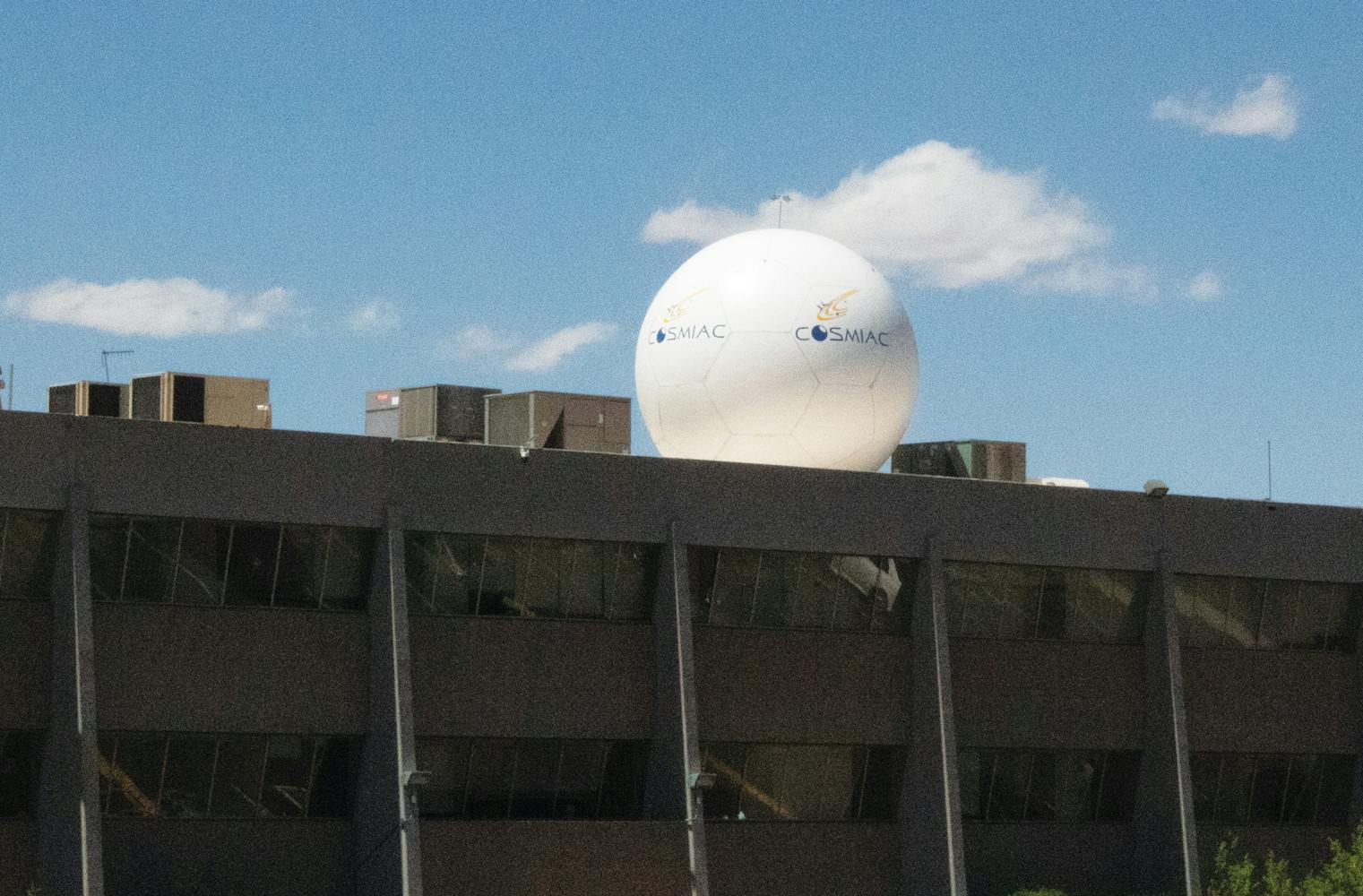
COSMIAC brings together facilities, people, and technical capability to support government, industry, and academic aerospace research.
COSMIAC supports mission concepts, spacecraft subsystem development, satellite communications, controls, systems integration, and hands-on small satellite program execution.
Radiation studies, testing support, modeling, mitigation, and part-selection activities help partners understand how electronics and systems perform in mission-relevant environments.
Research areas include RF communications, satellite ground systems, optical communications, positioning, navigation, timing, waveform analysis, and resilient operation in contested environments.
Additive manufacturing, mechanical design, electronics development, and visualization workflows help teams move quickly from concept to physical prototype.
COSMIAC supports an innovation ecosystem where small businesses can engage technical expertise, facilities, students, and university partnership pathways.
Students work on sponsor-relevant projects under COSMIAC engineering mentorship, gaining experience that supports New Mexico’s aerospace and defense workforce needs.
COSMIAC combines university research infrastructure with practical engineering space for development, testing, integration, and collaboration.
COSMIAC operates approximately 30,000 square feet of space across its Alamo Avenue facilities, including laboratories, cleanroom capability, development areas, offices, and high-bay space for larger-scale prototyping and integration.
The center’s technical work spans satellite communications, radiation effects, additive manufacturing, materials studies, rapid prototyping, optical and RF systems, space systems engineering, cybersecurity, and positioning, navigation, and timing.
COSMIAC is designed to make collaboration easier for organizations that need university research capability without losing the speed and focus required for mission-driven engineering.
COSMIAC supports both technology development and the people who will carry that technology forward.
COSMIAC hosts and supports small businesses working in areas such as laser communications, embedded systems, directed energy, spectroscopy, and related aerospace technologies. This creates a practical environment where companies, researchers, and students can interact around real technical needs.
By combining business acceleration, student engagement, and technical infrastructure, COSMIAC helps strengthen the regional aerospace innovation base.
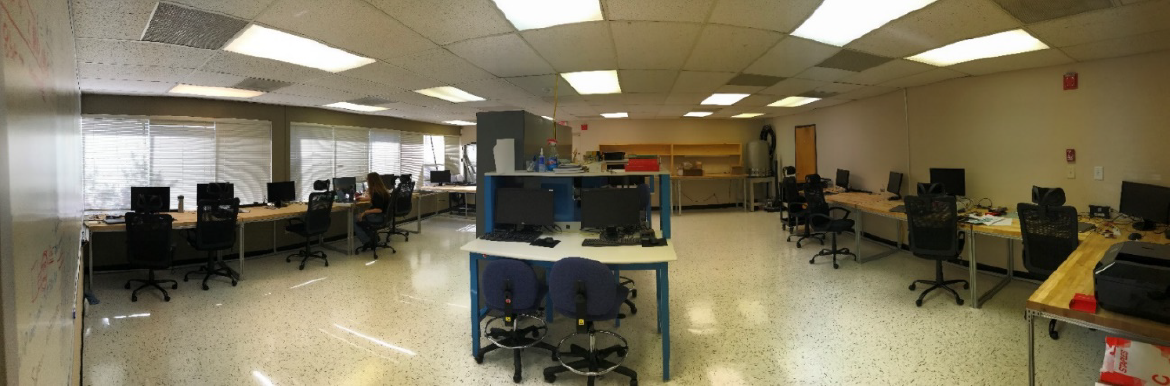
Above: COSMIAC student incubator and collaboration space.
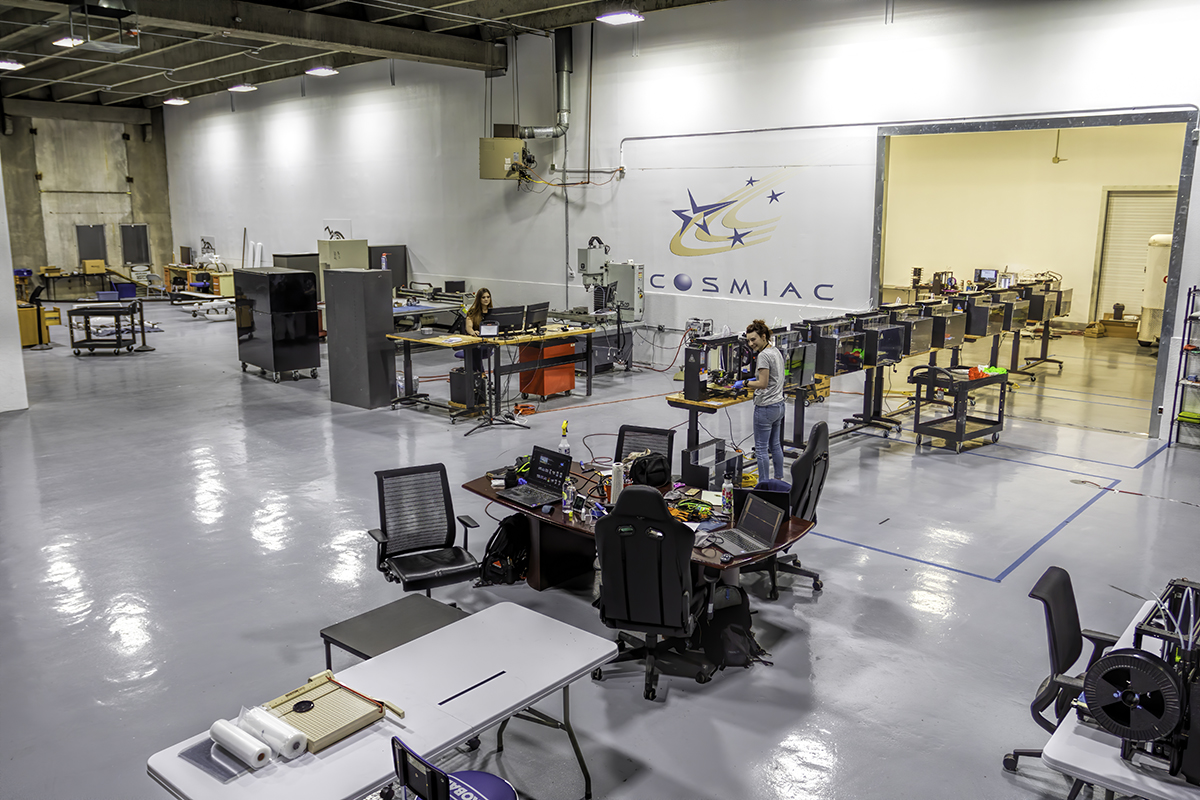
Above: Rapid prototyping and 3D printing in the COSMIAC high bay space.
COSMIAC helps sponsors move faster while creating a stronger local workforce. Partners can engage technical teams without building every internal capability from scratch, while students gain direct experience on aerospace and defense projects that matter to regional and national missions.
This approach supports UNM’s educational mission, strengthens New Mexico’s aerospace economy, and helps government and industry partners access motivated technical talent.
Learn more about our people, technical capabilities, facilities, business opportunities, and current research areas.

© The University of New Mexico
Albuquerque, NM 87131, (505) 277-0111
New Mexico's Flagship University